
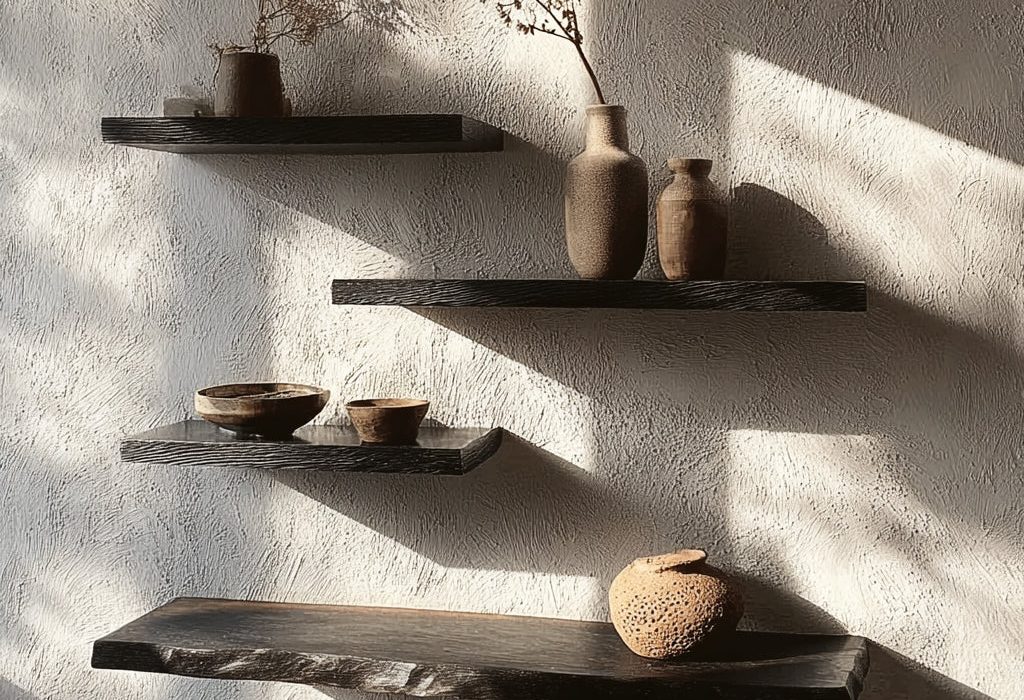
Open Shelf Styling Ideas Without Making Rooms Feel Busy
Open shelves can provide storage and personality, but they quickly become visually noisy when every inch is filled. The simplest approach is to treat empty shelf space as part of the design. Fewer, better-grouped objects usually make shelves look more intentional while keeping everyday items easy to reach.
Decide What Deserves to Stay Visible
Not every useful item needs to become part of the display. Start by separating objects you enjoy seeing from items that are better stored in drawers, baskets, or cabinets.
Open shelves look calmer when they contain things with a clear visual or practical role. Remove duplicates, packaging, and objects that remain visible only because there is nowhere else to put them.
Group Instead of Spreading
Three small objects grouped together often look quieter than those same objects spread across an entire shelf. Grouping creates one visual moment instead of several separate points competing for attention.
Mix Practical and Decorative Objects
Shelves feel natural when they include things people actually use. Books, bowls, storage boxes, and serving pieces can sit beside art or plants instead of being replaced completely by decoration.
Looking at home interior inspiration can help demonstrate how useful objects become part of a room’s visual character. The goal isn’t to disguise function but to arrange it with enough order that the shelf stays readable.
| Shelf Item | Best Styling Role | Calmer Choice |
|---|---|---|
| Books | Adds height and structure | Use grouped runs |
| Baskets | Hides small clutter | Repeat one style |
| Ceramics | Adds shape | Display selected pieces |
| Plants | Softens hard lines | Choose manageable sizes |
Leave Deliberate Empty Areas
Empty space prevents every object from demanding equal attention. Instead of placing something in the middle of every shelf, allow some sections to remain completely clear.
Examples from spacious residential designs can inspire this idea, but it also works in small homes. In fact, smaller rooms may benefit even more because shelves already introduce many horizontal lines.
Try removing one object from each crowded shelf and living with the change for a day. Often the arrangement immediately feels calmer.
Control Repetition Across Several Shelves
Repeating a limited set of materials creates continuity. Wood, white ceramic, black metal, or woven textures can reappear without requiring identical accessories.
Broader interior organization ideas can help inspire balanced storage choices where practical containers blend with display pieces. Consistency matters more than perfect matching.
Change Height Without Creating Chaos
Use books, boxes, or stands to create different object heights. Avoid putting a tall item in exactly the same position on every shelf, which can make the arrangement look rigid.
Why Open Shelves Become Too Busy
The problem is often quantity rather than color. Even a perfectly neutral shelf can look cluttered if it holds dozens of similarly sized objects.
Another mistake is styling every shelf as a separate miniature scene. When each level contains a plant, frame, candle, books, and decorative bowl, repetition becomes obvious. Let some shelves focus on books, others on storage, and a few on decorative objects.
Frequently Asked Questions
Should every shelf have decorations?
No. Some shelves can be almost entirely practical, while others carry decorative pieces. Variation keeps the overall arrangement from looking overly staged.
How do you style shelves with lots of books?
Keep books in grouped sections and vary their lengths naturally. A few horizontal stacks can break up long rows, but avoid removing so many books that storage stops serving its purpose.
Do open shelves make a small room look smaller?
They can if heavily packed with contrasting objects. Lighter editing, consistent storage containers, and visible gaps can help shelves feel less visually dominant.
Edit the Shelf Until the Room Feels Quieter
The final test isn’t whether every object looks attractive on its own. Step back and look at the whole wall. If your eyes jump constantly from one item to another, remove or regroup a few pieces. Strong open-shelf styling gives useful belongings room to exist without asking every object to become a focal point.